Understanding your mortgage and what it does
Five diagrams, plain English, no jargon. How the bank calculates your interest, and what redraw, offset, interest-only, fixed, variable, investment and owner-occupied actually mean for your money.
How the bank charges you interest
Interest is simply the rent you pay for borrowing the bank's money. The bank doesn't charge it once a year like a bill — it quietly counts it every single day on whatever you still owe, then adds it to your loan once a month.
One thing to burn into memory: interest is charged on your balance, not on what you originally borrowed. Every dollar you pay off the loan shrinks the balance, and a smaller balance means a smaller daily charge. That is why every extra dollar counts.
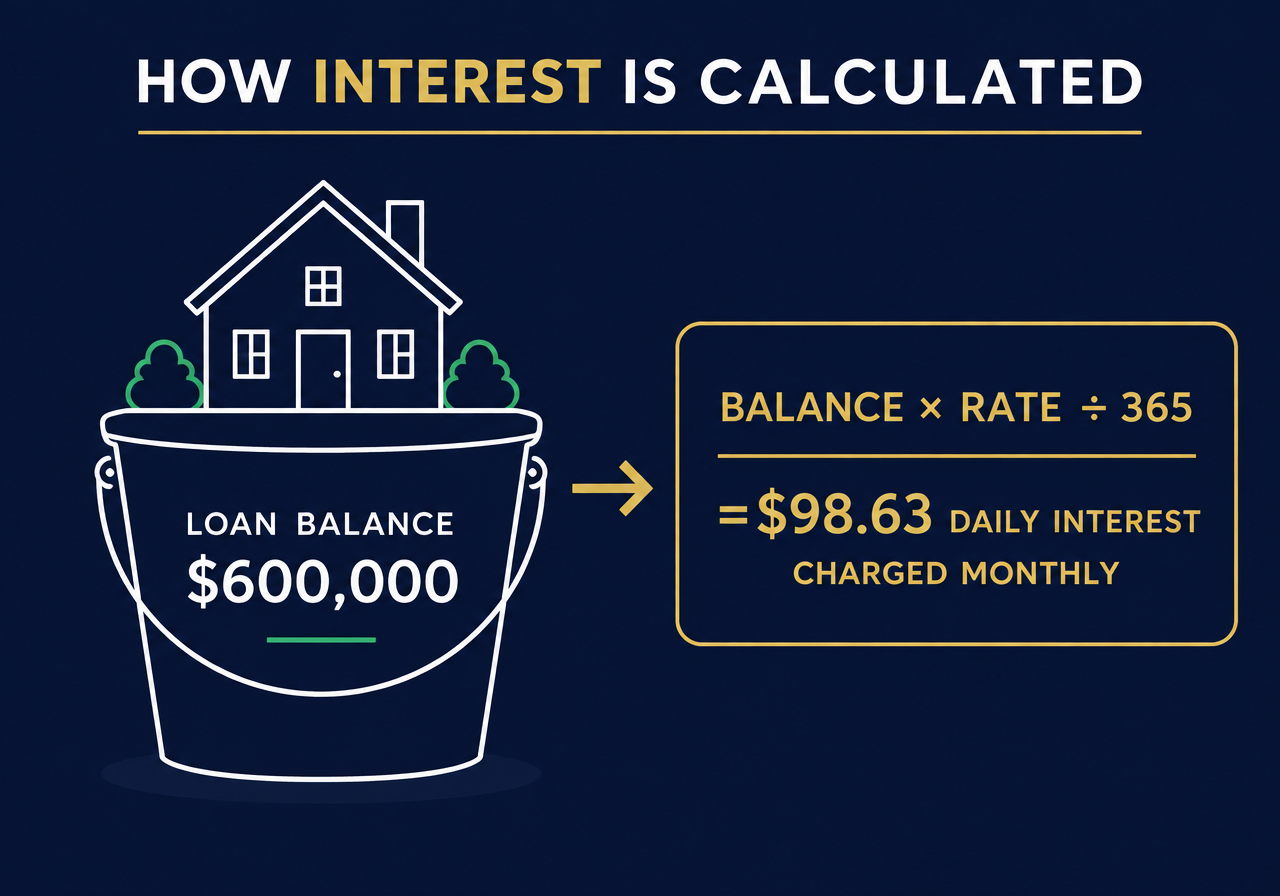
Worked example
Balance $600,000 × 6% ÷ 365 = about $98.63 a day. That's roughly $3,000 a month before a single dollar of the actual debt has been touched. When your balance drops, that daily number drops with it.
Redraw vs offset — where does your spare cash live?
When you open your banking app, you only ever see two accounts — the home loan and the offset account. Redraw is not a separate account: it lives inside the home loan.
Home Loan — the debt itself, with its own BSB and account number. The card shows your limit (the $400,000 you borrowed) and your balance (what you actually owe today). Say you have $50,000 of spare money and you put it in redraw: those extra repayments genuinely shrink the debt, so the balance drops to −$350,000 and a line underneath shows "redraw available: $50,000" — money you can pull back out if you need it.
Offset account — a completely separate, normal-looking savings account with its own BSB and account number. Your salary goes in, your bills come out. The magic: the bank subtracts this balance from the loan before calculating interest. Same $50,000 sitting in offset means the loan balance stays at −$400,000, but interest is charged on $350,000.
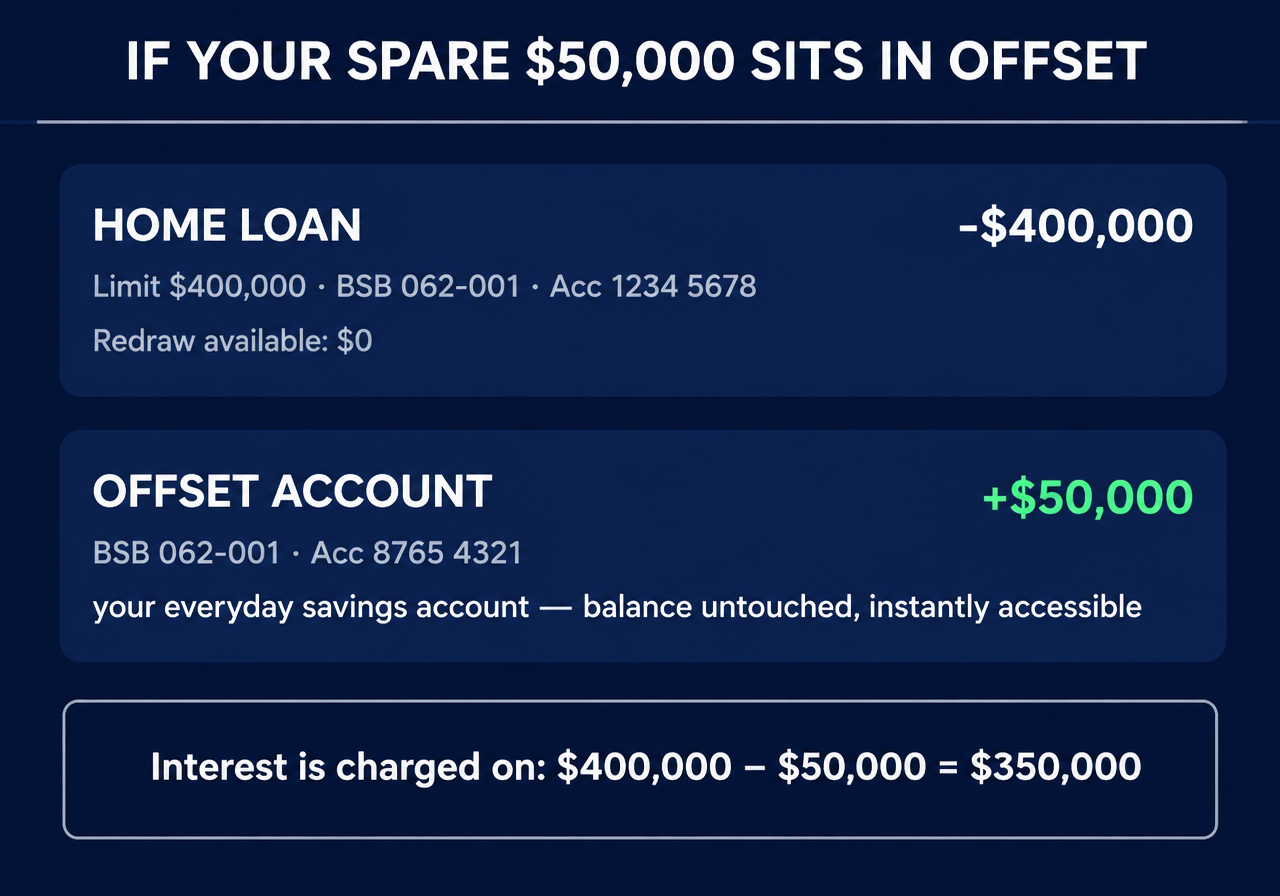
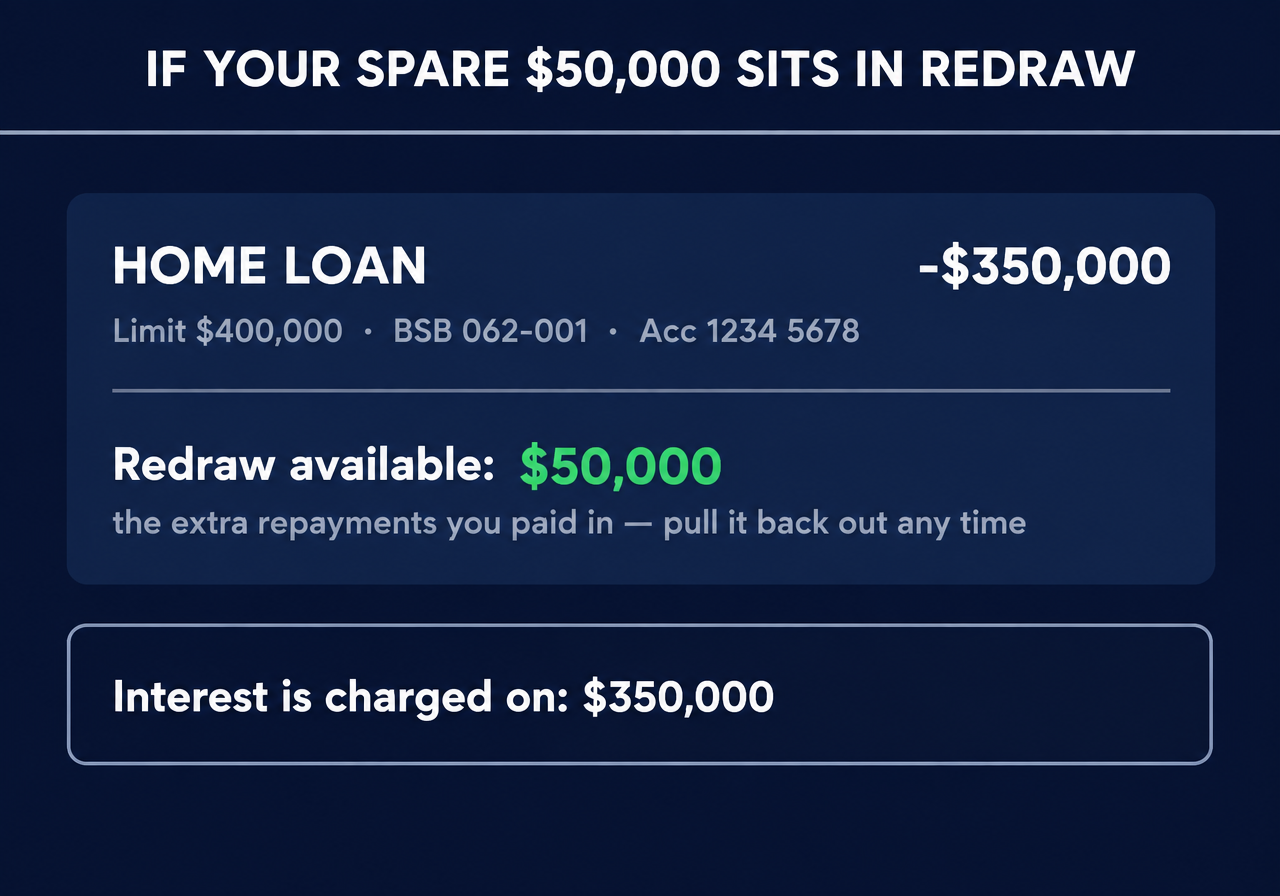
- Offset: your savings sit in a separate transaction account. Interest is charged on loan − savings. Money stays instantly accessible, like a normal savings account — but it typically earns no interest of its own.
- Redraw: your extra repayments are already inside the loan. Interest falls because the balance is genuinely smaller. You can withdraw it back, but some lenders impose minimums, caps or fees, and it can take a business day or two.
- Same effect on interest — different flexibility. In both pictures the bank charges interest on $350,000. An offset leaves your money more liquid. Redraw nudges you to keep the money committed.
- Watch the loan type: some basic or fixed loans have no offset or redraw at all, or charge for it.
Worked example
Either way, a $400,000 loan with $50,000 parked in offset or redraw means interest is charged on $350,000. At 6% p.a. that saves roughly $250 every month — the same saving in both scenarios. The difference isn't the interest, it's how easily you can get the money back: offset is instant, redraw can take a day or two and may have limits.
Interest only vs principal & interest — renting money or buying it down
A principal & interest (P&I) repayment does two jobs: it covers the interest, then pays a slice of the actual debt. An interest-only repayment does only the first job. It's the difference between renting money and slowly buying it.
Interest-only gives you a smaller repayment today — handy for short-term cash flow — but the balance never moves. When the interest-only period ends (typically after 1–5 years), the repayments jump, because the full debt must be repaid over a shorter remaining term. Meanwhile, you paid interest on the full balance the entire time.
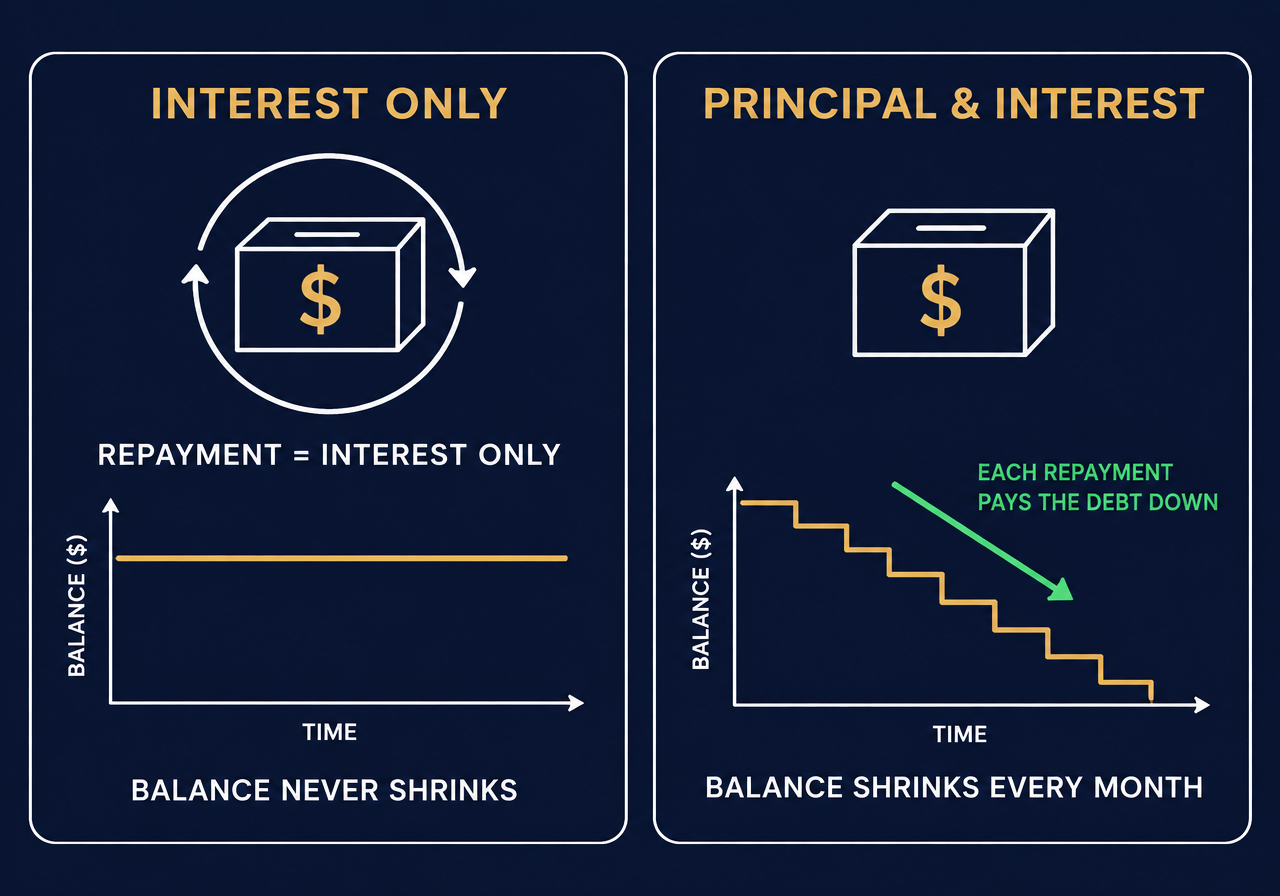
Worked example
On a $600,000 loan at 6% p.a., interest-only costs about $3,000 a month. A P&I repayment over 30 years is about $3,597 a month — and that extra ~$597 is what actually buys your debt down, month after month.
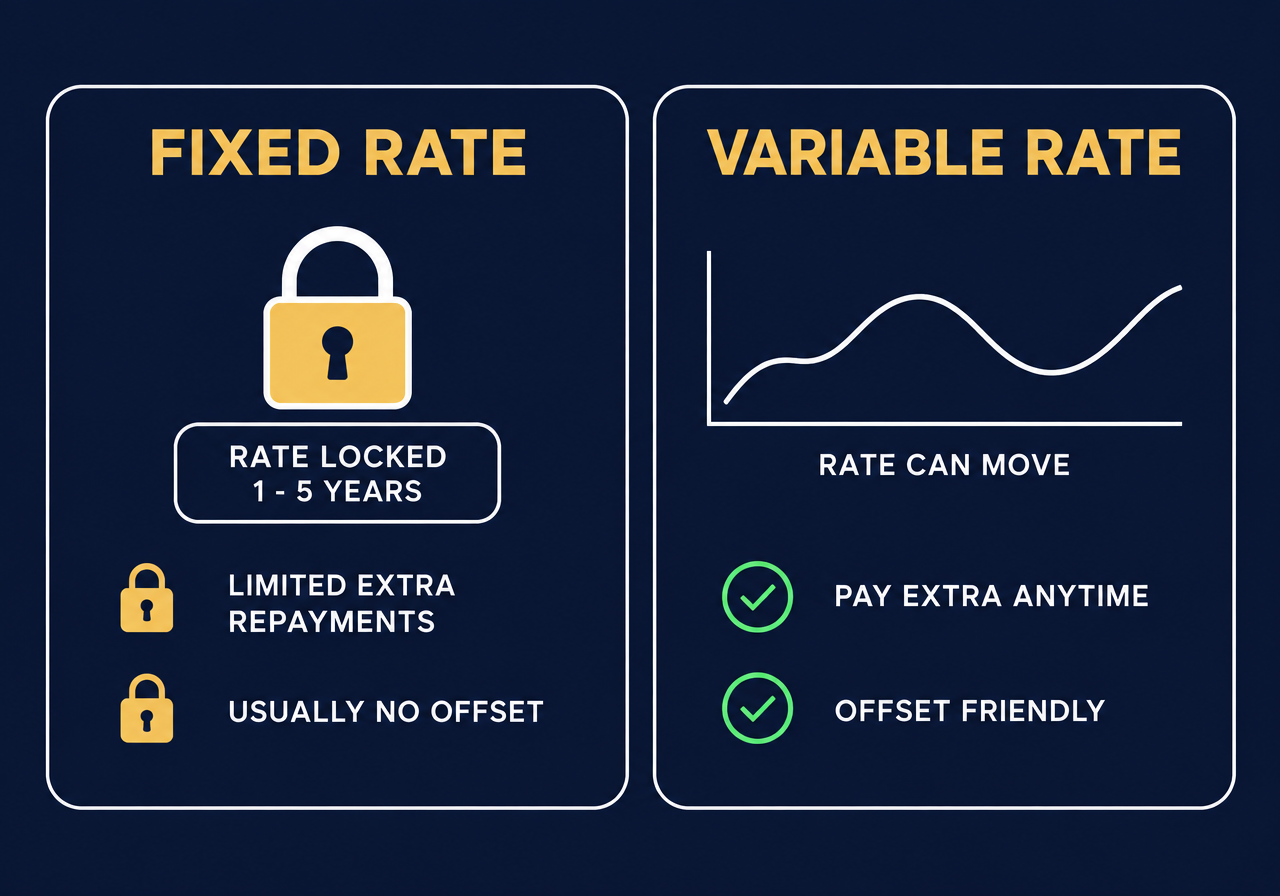
Fixed vs variable — a locked ticket or a floating one
A fixed rate locks your rate for a set period, usually one to five years. You know exactly what every repayment will be, which makes budgeting simple — but the ticket has rules attached.
A variable rate floats with the market. It can move up or down, but you get flexibility: pay extra whenever you like, an offset account, and no break costs if you repay early or switch.
The trade-offs to remember: fixed loans are normally restricted on extra repayments and usually don't include an offset facility. If you fix, the levers that save you the most interest — extra repayments and offset — are mostly taken off the table for that period. Many clients use a fixed rate for certainty and keep part of the loan variable; others stay fully variable for the flexibility. It depends on what your money is doing, and that's worth a conversation.
Investment vs owner-occupied — which house is the loan for?
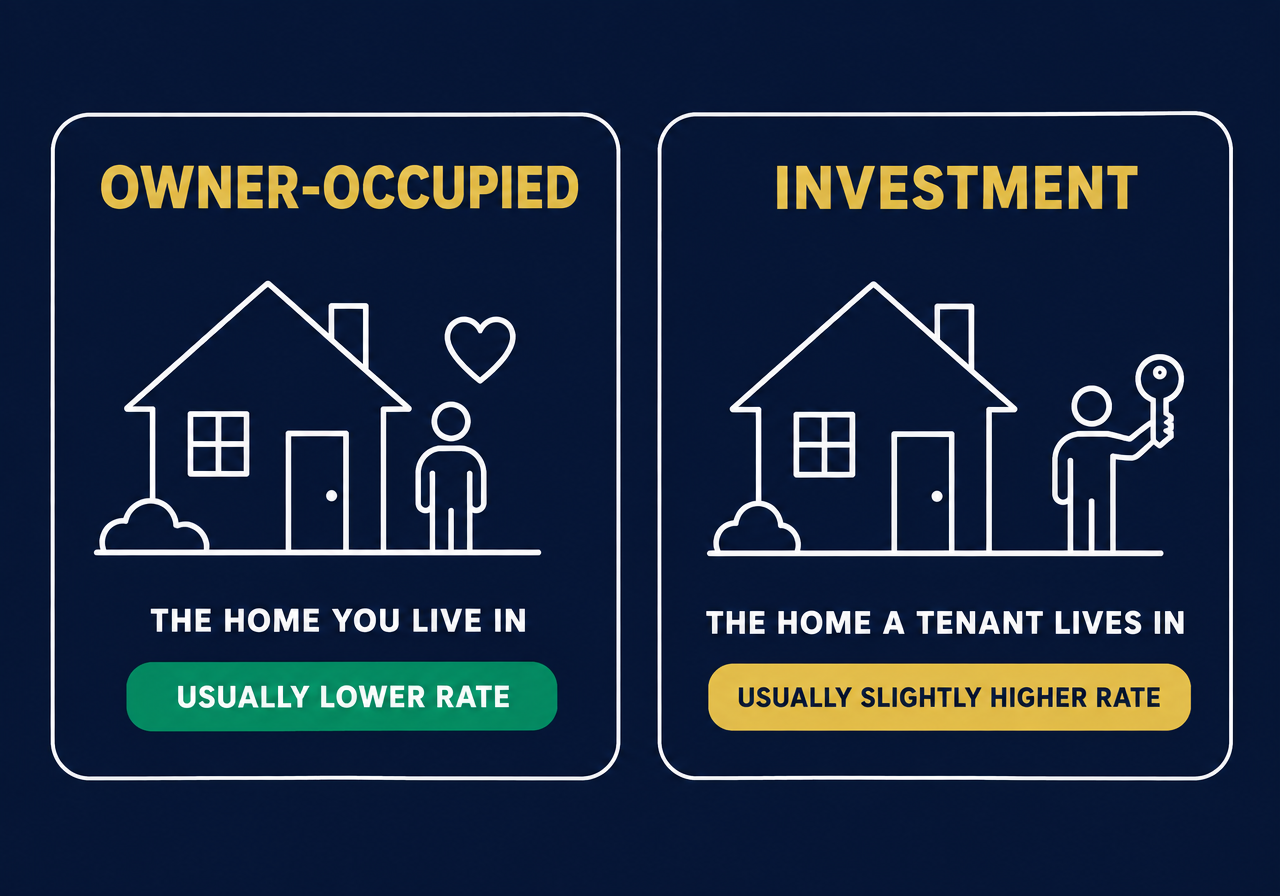
The bank asks one question before pricing your loan: who will live in the property?
An owner-occupied loan is for the home you live in. Lenders see it as lower risk — people protect the roof over their own heads first — so these loans are usually priced at the lender's sharpest rates.
An investment loan is for a property a tenant lives in. The rate is usually slightly higher, because if circumstances change, the tenant's home is easier to give up than your own. On the flip side, the interest on an investment loan is generally tax-deductible — your accountant, not the bank, is the person to confirm what that means for you.
The 30-second recap
| Term | In one sentence |
|---|---|
| Interest | Rent on borrowed money, counted daily on your balance and billed monthly. |
| Offset | A savings account the bank subtracts from your balance before charging interest. |
| Redraw | Extra repayments parked inside the loan — smaller balance, take the cash back later. |
| Interest only | Paying only the interest; the debt never shrinks during the interest-only period. |
| Principal & interest | Interest plus a slice of debt, so the balance falls every month. |
| Fixed | Locked rate for 1–5 years; limited extra repayments and usually no offset. |
| Variable | Rate can move, but you keep offset, unlimited extra repayments and freedom to switch. |
| Owner-occupied | The loan for the home you live in — usually the sharpest pricing. |
| Investment | The loan for a property a tenant lives in — slightly higher rate, possibly tax-deductible. |
Examples use round numbers for illustration only. Rates and figures change; your own numbers depend on your lender, loan and situation. General information only, not personal financial advice.
More questions
Do I need both an offset account and a redraw?
Not necessarily. An offset account suits people who keep savings sitting around and want instant access. Redraw suits people who prefer to throw spare cash straight at the loan and pull it back only when needed. Many products offer one or the other — some offer both.
Is interest-only cheaper?
The monthly repayment is smaller, but you never shrink the debt. After the interest-only period ends, the repayments jump because the loan then has to be paid off over a shorter remaining term, and you have paid interest on the full balance the whole time.
Can I get an offset account on a fixed rate?
Usually not. Most fixed-rate loans do not include an offset facility, and they restrict how much extra you can repay each year. A variable rate is where offset accounts and unlimited extra repayments typically live.
Can I switch from fixed to variable?
Yes, but breaking a fixed loan early can trigger break costs, which can be significant if rates have moved since you fixed. We can walk you through the numbers before you make the move.
Why is an investment loan rate higher than an owner-occupied rate?
Lenders price investment lending slightly higher because a loan tied to a rental property carries more risk if circumstances change. The upside is that investment loan interest is generally tax-deductible — talk to your accountant about your situation.
Let’s map your next property move.
Honest, advisory-first lending guidance from a senior Sunshine Coast broker. No pitch, just clarity.
Book a Consultation